
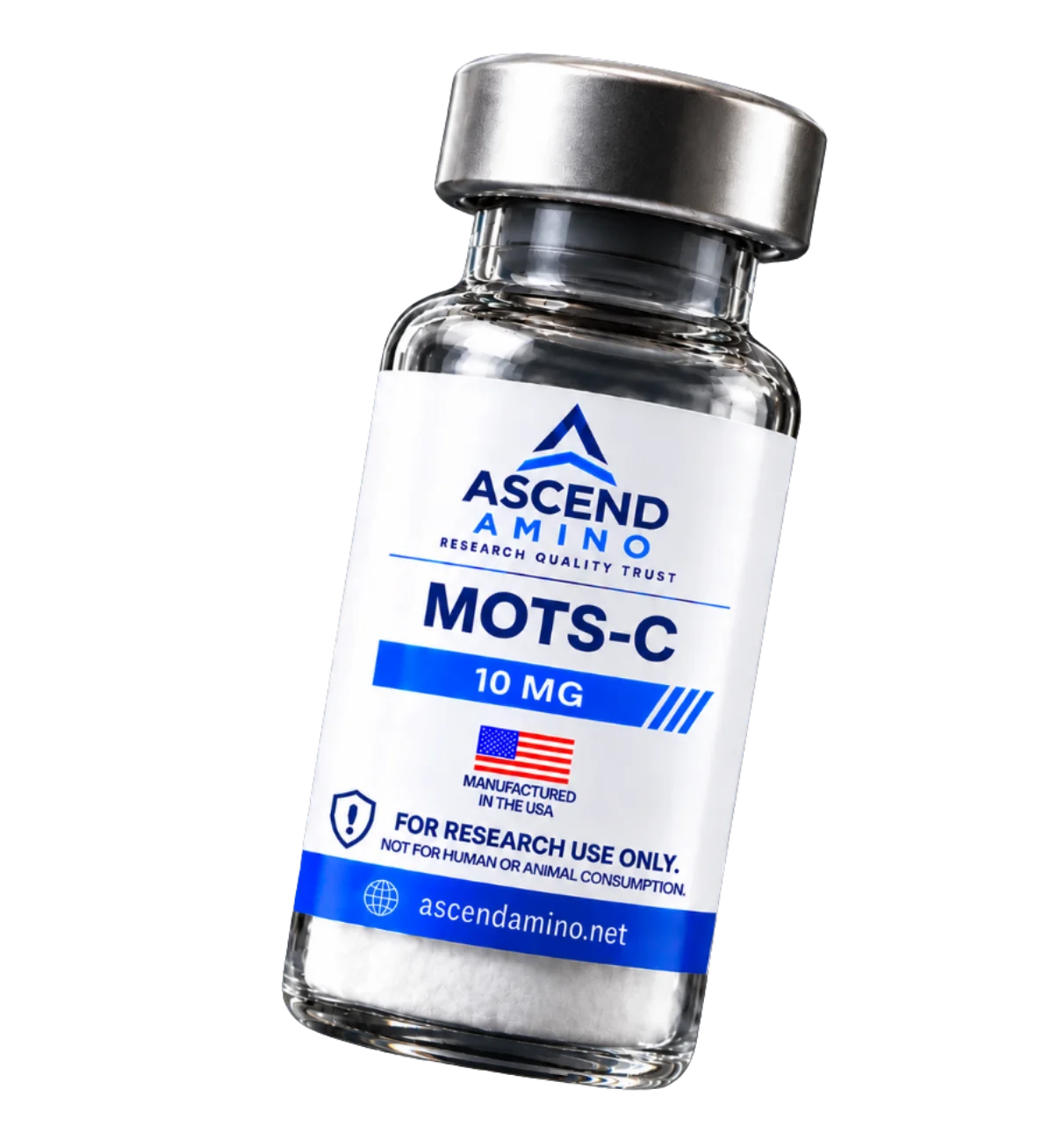
MOTSc 10 MG

$44.00
MOTS-c 10mg is a mitochondrial-derived peptide studied for its potential role in cellular energy regulation, metabolic signaling, and mitochondrial communication. Encoded by mitochondrial DNA, MOTS-c has attracted scientific interest because of its relationship with metabolic pathways, including AMPK-related signaling. Researchers investigate this peptide to better understand mitochondrial function and cellular responses to metabolic stress. This product is intended strictly for controlled laboratory and scientific research, not for human or veterinary use.
MOTS-c 10mg: Understanding This Mitochondrial-Derived Research Peptide
What Is MOTS-c 10mg?
MOTS-c 10mg is a synthetic version of a naturally occurring mitochondrial-derived peptide that has become an important subject in metabolic and cellular biology research. Unlike many peptides encoded by nuclear DNA, MOTS-c originates from a short open reading frame within mitochondrial DNA.
Mitochondria are commonly known as the energy-producing structures of cells. However, research has increasingly explored their role in cellular communication and metabolic regulation. MOTS-c is particularly interesting because it may act as a signaling molecule connecting mitochondrial activity with broader cellular responses.
The 10mg designation refers to the labeled quantity of the compound. Researchers should consult supplier documentation to verify its identity, purity, and formulation.
Understanding the Structure of MOTS-c
MOTS-c is a short peptide consisting of 16 amino acids. Its name refers to its mitochondrial origin and its classification as a mitochondrial-derived peptide.
The discovery of MOTS-c expanded scientific understanding of mitochondria beyond their traditional role in energy production. Researchers now investigate how mitochondrial genetic information may contribute to signaling processes that influence cellular activity.
Its relatively short amino acid sequence makes MOTS-c a useful subject for studying peptide structure, molecular interactions, and mitochondrial communication.
MOTS-c and Cellular Energy Regulation
One of the major areas of MOTS-c research involves cellular energy metabolism.
Cells rely on complex biochemical pathways to produce and manage energy. These pathways respond to nutrient availability, energy demand, and different forms of metabolic stress.
MOTS-c has attracted attention because experimental research suggests a relationship with AMP-activated protein kinase (AMPK), an enzyme that acts as an important cellular energy sensor.
AMPK helps coordinate metabolic responses when cellular energy levels change. Investigating the relationship between MOTS-c and AMPK may help researchers better understand how mitochondria communicate with other parts of the cell.
The Role of MOTS-c in Metabolic Research
Researchers have investigated MOTS-c in connection with several metabolic pathways, including glucose utilization, energy balance, and cellular responses to metabolic challenges.
These studies are relevant because metabolism involves multiple interconnected systems. Understanding how mitochondrial-derived peptides participate in cellular communication may provide additional insight into metabolic regulation.
Current research includes experimental investigations into:
- Mitochondrial signaling
- AMPK-related activity
- Cellular energy regulation
- Glucose metabolism
- Metabolic stress responses
- Peptide-based cellular communication
Much of the available evidence remains preclinical. Experimental findings do not establish that MOTS-c is safe or effective for treating metabolic conditions in humans.
MOTS-c and Mitochondrial Communication
Mitochondria perform several important functions beyond producing cellular energy. They also participate in signaling pathways that help cells respond to changes in their environment.
MOTS-c is studied as part of this broader area of mitochondrial communication. Researchers investigate how peptides originating from mitochondrial DNA may influence cellular processes outside the mitochondria themselves.
This research may contribute to a better understanding of the relationship between mitochondrial function, genetic signaling, and cellular adaptation.
Why MOTS-c 10mg Is Interesting to Peptide Researchers
MOTS-c offers a distinct research subject because of its mitochondrial origin and proposed involvement in metabolic signaling.
Its scientific relevance includes:
- Mitochondrial-derived peptide biology
- Cellular energy metabolism
- AMPK signaling research
- Metabolic regulation
- Glucose-related biochemical pathways
- Mitochondrial communication
- Molecular peptide characterization
These areas continue to develop as researchers explore the relationship between mitochondrial activity and cellular regulation.
Product Characteristics of MOTS-c 10mg
When evaluating MOTS-c 10mg as a research compound, laboratories should review its product specifications and available quality documentation.
Key product details include:
- Product name: MOTS-c
- Labeled quantity: 10mg
- Peptide length: 16 amino acids
- Compound category: Mitochondrial-derived peptide
- Research focus: Mitochondrial signaling and metabolic regulation
- Intended setting: Controlled laboratory and scientific research
Product identity, purity, peptide sequence, and analytical testing should be confirmed through supplier documentation.
Research-Only Notice
MOTS-c 10mg is presented strictly for controlled laboratory and scientific research purposes. It is not intended for human or veterinary consumption, injection, diagnosis, treatment, or prevention of disease. Research findings should not be interpreted as proof of clinical effectiveness or medical approval.
Final Overview
MOTS-c 10mg is a mitochondrial-derived peptide that has attracted scientific interest because of its proposed involvement in cellular energy regulation and metabolic signaling. Its relationship with AMPK-related pathways and mitochondrial communication makes it a distinctive subject in peptide and metabolic research.
For responsible scientific evaluation, laboratories should verify the compound’s identity, composition, purity, and quality documentation before conducting research.
Be the first to review “MOTSc 10 MG”
Related products


PEPTIDES

Reviews
There are no reviews yet.